
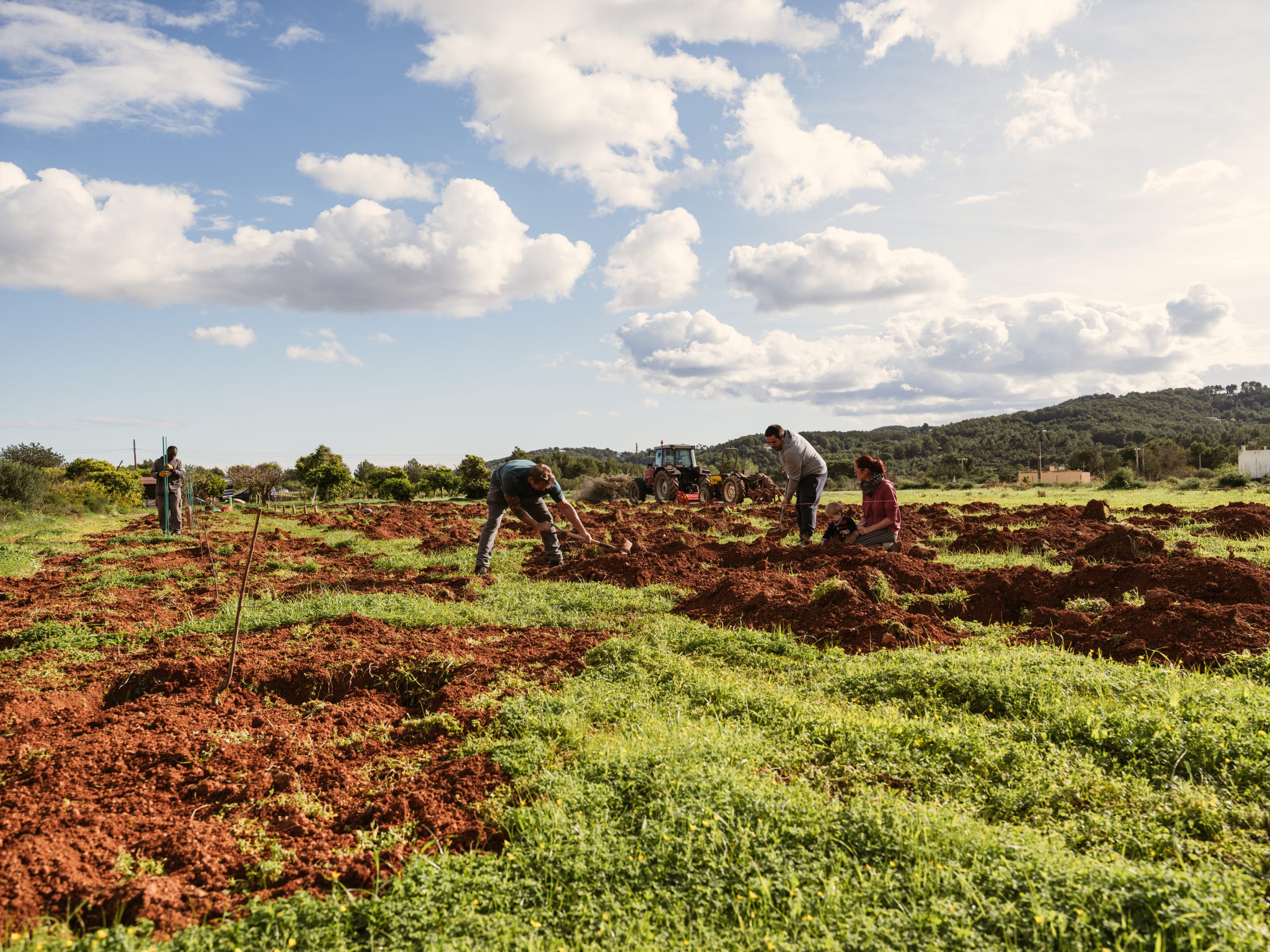
The Ibiza & Formentera Preservation Sustainability Observatory warns that this progress must be accompanied by measures to strengthen and guarantee the continuity of the agricultural sector.
Ibiza, September 1, 2026 – The usable agricultural area (UAA) in organic farming in Ibiza reached 1,590 hectares in 2025, more than double the 792 hectares recorded in 2020. In five years, its share of the island’s total agricultural area increased from 8.8% in 2020 to 20.4% in 2025, placing it 4.6 percentage points away from the European target of 25% organic agricultural land by 2030 .
The data, provided by the Institut de Recerca i Formació Agroalimentària i Pesquera de les Illes Balears (IRFAP) and the Consell Balear de Producció Agrària Ecològica (CBPAE), are part of the Ibiza 2025 Sustainability Report, prepared by the Sustainability Observatory of Ibiza & Formentera Preservation and financed entirely by the Consell Insular d’Eivissa.
In the last year alone, the area of organic farmland increased by 138 hectares , going from 1,452 hectares in 2024 to 1,590 in 2025, which represents a growth of 9.5%.
“The increase in organic farmland is good news, but this data must be interpreted within the context of the limited scale of agricultural activity in Ibiza. The growth of organic farming must be accompanied by measures that allow us to maintain and strengthen the island’s agricultural sector ,” warns Elisa Langley , coordinator of the Ibiza & Formentera Preservation Sustainability Observatory.
Sant Antoni registered the largest increase
Between 2024 and 2025, the area registered as organic farming increased in four of the island’s five municipalities and remained stable in Ibiza. The largest increase occurred in Sant Antoni, which went from 341 hectares in 2024 to 393 in 2025, an increase of 52 hectares and a growth of 15.25%.
Next was Sant Josep , which increased from 443 hectares in 2024 to 494 in 2025, a gain of 51 hectares and an 11.51% increase. In Sant Joan , the area increased by 26 hectares, from 284 in 2024 to 310 in 2025, a 9.15% increase. Santa Eulària grew from 380 to 385 hectares, an increase of five hectares and a 1.32% growth , while Ibiza remained at four hectares in both years.
Thus, in 2025 Sant Josep was the municipality with the largest area of organic farmland, with 494 hectares, followed by Sant Antoni (393 ha), Santa Eulària (385 ha), Sant Joan (310 ha) and Eivissa (4 ha).
Regarding the different uses and organic crops, the largest increase compared to 2024 was for forest and wild harvesting, whose area increased by 15.6% in 2025, mainly related to livestock farming in wooded areas. The area dedicated to vineyards (+13.6%) , cereals and legumes (+12.7%), citrus fruits (+12.5%) , and nuts (+11.0%) also increased.
The number of operators is growing, but not the number of producers.
The number of organic operators —which includes both those who produce agricultural raw materials and those who process or transform organic products—increased from 161 in 2024 to 171 in 2025. All ten new operators were processors , while the number of producers remained stable. “This trend reflects greater dynamism in the later stages of the value chain, although it also shows that the increase in operators did not translate into an expansion of the local organic production base. It will be necessary to analyze the evolution of certified land area and the origin of raw materials to determine whether this growth truly strengthens Ibiza’s primary sector,” explains Langley.
In perspective, the number of ecological operators has more than doubled over the last decade, going from 84 in 2015 to 171 in 2025 , and has maintained an upward trajectory since 2005 without registering any declines.
Regarding the organic flock, in Ibiza there was only sheep and poultry production in 2025. The figures also did not change compared to 2024: the number of birds remained at 7,525 and the number of sheep at 82 .
The Ibiza & Formentera Preservation Sustainability Observatory points out that, beyond food production, organic farming contributes to maintaining the agricultural landscape and traditional land uses, conserving the soil and biodiversity associated with agricultural areas, and increasing the resilience of the island’s agri-food system .
Therefore, they consider it necessary to strengthen support for the agricultural sector through aid and specific programs adapted to the reality of Ibiza, facilitate the marketing and promotion of local products , support the maintenance of farms and encourage generational renewal .
“On an island subject to problems such as drought, fires or pests , maintaining a viable agricultural activity is also a way to protect the territory and increase its capacity for adaptation ,” Langley concludes.


